Stevens Physics Paper Ranked 2024’s Most Popular by Nature Communications
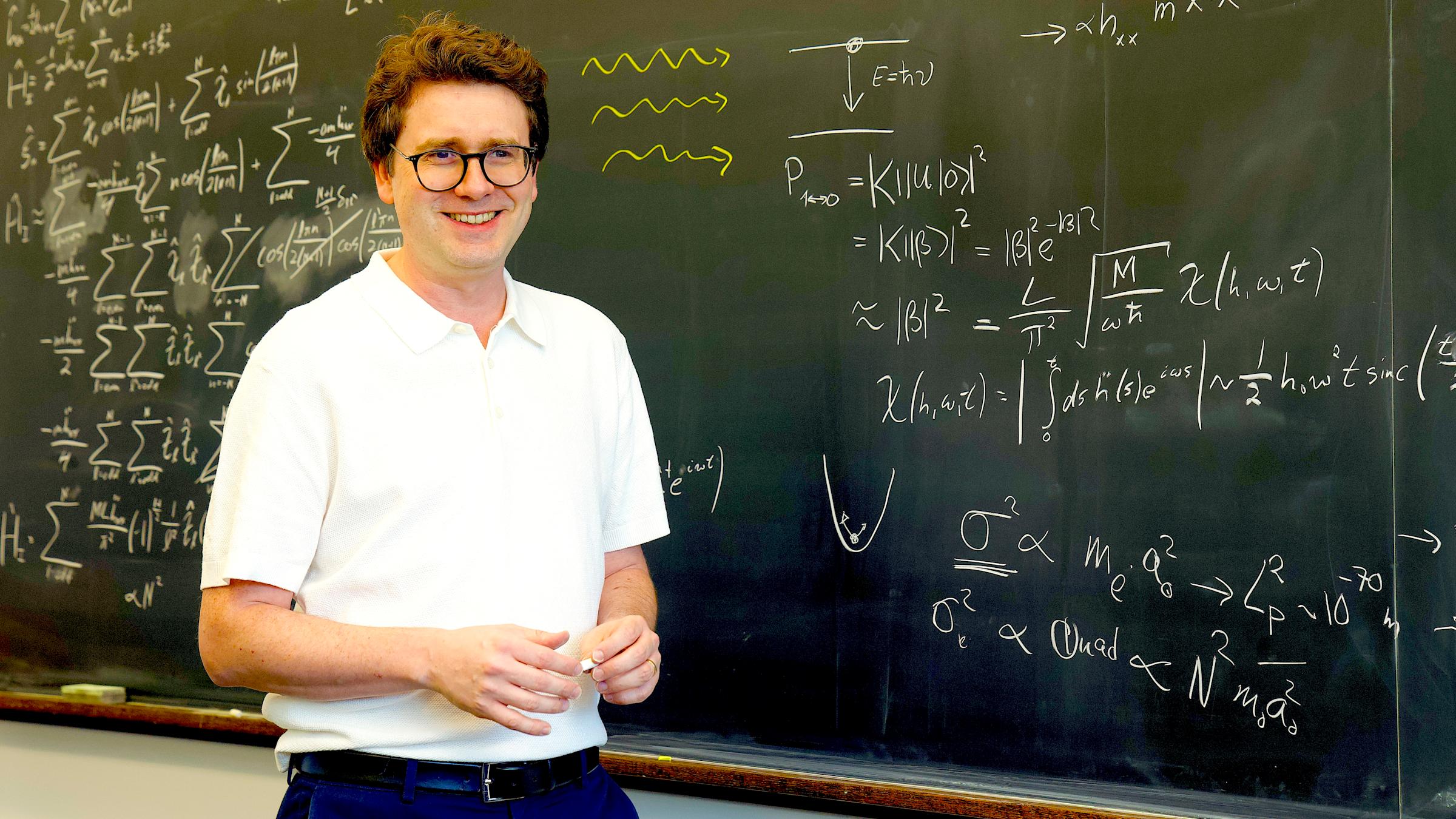
One of the world’s leading scientific journals recognizes physicist Igor Pikovski’s work on a method to detect gravitational particles — a task once thought impossible
Stevens physicist Igor Pikovski’s paper on quantum gravity particle detection was far and away the most-downloaded of the year in physics in Nature Communications, one of the world’s leading science journals, the publication announced March 5. The paper appeared atop the journal's "Top 25 Physics Articles of 2024" recap.
Pikovski’s paper “Detecting single gravitons with quantum sensing,” co-authored with graduate students Germain Tobar and Thomas Beitel and postdoctoral researcher Sreenath Manikandan, was accessed approximately 34,000 times worldwide in 2024, 25% more than the journal’s next-most popular physics paper.
New avenues for quantum gravity research
The revolutionary paper proposes a theoretical method for capturing graviton absorption events, using quantum sensing technologies that are now within the reach of science.
Pikovski’s group proposes a super-cooled detector bar of beryllium or a similar metal, interacting with one of the periodic gravitational waves that occurs after a large neutron-star collision in space and passes through the Earth.
When some of those waves, loaded with gravity particles, encounter the prepared bars they will resonate with the bars, causing a small but distinct “jump” up a step of quantum energy. The single jumps can be resolved and correspond to the absorption of only a single graviton – something thought to be impossible to detect previously.
It's a challenging scenario, preparing and keeping a sensor bar in a very low-energy state, then monitoring its change to another extremely low (but slightly higher-energy) state.
Still, the experiment should work to confirm the predictions of quantum gravity according to Pikovski’s calculations — and his group’s careful technical demonstration in the paper has set the physics world on fire.
“It’s a big honor that our paper is of interest to the broad physics community,” said Pikovski. “Graviton detection was thought impossible, but now I hope that our result will open new opportunities for fundamental physics where we can test quantum gravity in the lab.”
“It's very exciting to me that detecting gravitons, and therefore testing aspects of quantum gravity, is no longer science fiction. This is a new perspective on the possibilities for experiments and the updating of previous ‘common wisdom’ in physics about quantum gravity.”
The original paper appeared in Nature Communications in August 2024 [Vol. 15, No. 7229].